Vision Zero: Working towards zero deaths on our roadways
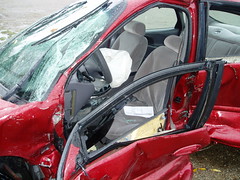
Car Crash by Schaapy on FlickR
Motor vehicle collisions kill about 40,000 people each year in the U.S. They injure and maim many others.When I have mentioned this idea over the years, it has been met with incredulity, disbelief, or just apathy--the idea of reducing traffic deaths by 30,000 per year is so dramatically distant from our everyday understanding that we just can't accept that it can be done.
Bicyclists and pedestrians bear a disproportionate share of that burden.
Other countries have pioneered simple, inexpensive, common-sense measures that have been proven to reduce these injuries and fatalities by 75%.
But here is a recent article by Mark Rosenburg detailing a country where it is being done--and very successfully:
Three years ago, I was driving in Atlanta early one morning when I saw a body on the road. It was a young female runner. I called 911 and then ran to her. She had a horrendous head injury but still had a heart beat. I started CPR, but her injuries were too severe. She died in my hands. I wrote a column in the Atlanta Journal-Constitution about what happened to the runner, and a flood of letters came in.
Half blamed the runner, saying she should not have been running in the street at that hour. Half blamed the driver, for not paying close enough attention. Not a single writer blamed the road.
I took a photograph of the scene where I had found the runner. When I showed this picture to friends from Sweden they asked, “This is where you live? This is your neighborhood? Your streets are designed to kill people.’’ They said that the thin painted white lines at the intersection could not be seen at dawn, nor was there a raised bump to or a narrowing of the road to demarcate the intersection and slow down traffic. They said the speed limit should be 30 kilometers per hour (about 18.6 miles per hour) or less if we wanted pedestrians to have much of a chance of surviving. They also said traffic lights increased the number of deaths because people often speed up when the light turns yellow.
When Sweden removed red lights from intersections and replaced them with traffic circles or rotaries, death rates at these intersections fell by 80 to 90 percent.
Sweden has also adopted a philosophy called Vision Zero, believing it can eradicate road traffic deaths.
Tags:
- News
- 2007
- 2009
- about
- accident
- accomplishments
- bicycle
- bicyclists
- completestreets
- crash
- death
- fatalities
- illinois
- injuries
- injury
- lights
- missouri bicycle federation
- mobikefed
- neighborhood
- opinion
- roads
- running
- speed
- St-Louis
- streets
- traffic
- vacation
- vision
- Atlanta
- Atlanta Journal
- driver
- Intersection
- Mark Rosenburg
- Road safety
- Road transport
- Roundabout
- runner
- the Atlanta Journal-Constitution
- Traffic
- Traffic circle
- Traffic law
- Traffic light
- Traffic signs
- writer
Join MoBikeFed's Advocacy Network
MoBikeFed is a statewide group of people like you, working together for better bicycling, walking, and trails in Missouri. When you join our advocacy network you receive occasional important advocacy alerts and bicycle, pedestrian, and trails news from around Missouri.
Working together we make a real difference! Join our advocacy network:
Working together we make a real difference! Join our advocacy network:
Related pages
Current topics...
Archives...
Want better bicycling and walking in Missouri?
We rely on the support of members like you. Please join, renew, or donate today.