Taking the Lane: Protected bike lanes--Do they help or hurt bicyclist safety?
Elly Blue, writing on her blog Take the Lane, finds that recent research has pretty well settled some decades-old debates among bicycle advocates:
Municipal leaders, advocates, and engineers in cities from Toronto to Tulsa, take note: The absurd debate about whether or not investing in bicycle-friendly streets is good for cyclists (and everyone else) is over. Done. Kaput. No longer deserving of a moment of your attention.
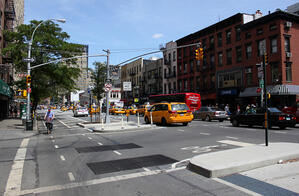
8th Ave Bike Lane in NYC.This debate has divided and distracted bicycle advocates for decades. I won’t give it any more air time here, and at any rate there is nothing new to say, but if you’re interested in exploring the one cycling topic more tediously and verbosely discussed than helmets, maybe start here.
For finally making the common sense of bike infrastructure in the US indisputable, we have the intrepid folks in New York City to thank. They have proven excellent in recent years at not only installing human-scale bike infrastructure, but quantifying its impacts.
In 2007, New York City added protected bike lanes, also known as “cycle tracks” to two previously car-centric one-way arterials in Manhattan, 8th and 9th Avenues. (This short movie explains more.) These lanes—basically, regular bike lanes with a physical barrier (often parked cars) and special signals at intersections in order to separate people on bikes from people driving and walking—were controversial before and after construction, with lots of dithering and yammering about how they would hurt business and freight, cause crashes, hold up traffic, and waste time and money.
The city’s transportation department released a study last October, however (I’ve been busy and just got in on the game this week), that puts much of that criticism to rest, with a zing. (Read about the study here or download the PDF here.)
First, on safety: True to form, this bike infrastructure did more than make cycling safer: The study found a 35% decrease in traffic crash related injuries to all street users on the 8th Ave path, and a whopping 58% on its 9th Ave counterpart.
What do you think--case closed? Looking forward to seeing protect bike lanes come to Missouri?
Seville, Spain is one of the most dramatic examples of a city growing the amount of bicycling very quickly. The city went from 0.4% bicycle mode share to 7% in five years. Seville's secret? A network of protected bicycle lanes throughout the city.
Photo credit: Bossi on FlickR. License: CC BY-SC-NA 2.0.
- 2007
- 2008
- 2012
- 2013
- about
- accident
- accommodation
- adventure
- adventure cycling
- bicycle
- bicycle lanes
- bicycling
- bicyclist
- Bike
- bike lanes
- blog
- business
- cars
- cities
- city
- construction
- crash
- crashes
- cycling
- fatalities
- first
- form
- game
- helmets
- infrastructure
- injuries
- injury
- missouri
- missouri bicycle federation
- mobikefed
- path
- photos
- research
- safety
- streets
- study
- traffic
- transportation
Related pages
Current topics...
Archives...
Want better bicycling and walking in Missouri?
We rely on the support of members like you. Please join, renew, or donate today.