Iron Riders: The Story of the 25th Infantry Regiment Bicycle Corps "Buffalo Soldiers" who bicycled from Montana to Missouri 125 years ago
One hundred twenty-five years ago in 1897, a group of "Buffalo Soldiers" made history by bicycling from Montana to Missouri. Missouri State Parks, who hosted a series of events this summer celebrating the Buffalo Soldiers' ride, has the details about who they were and why they rode:

Buffalo Soldiers walking their bikes along railroad tracks, 1897 (National Archives)
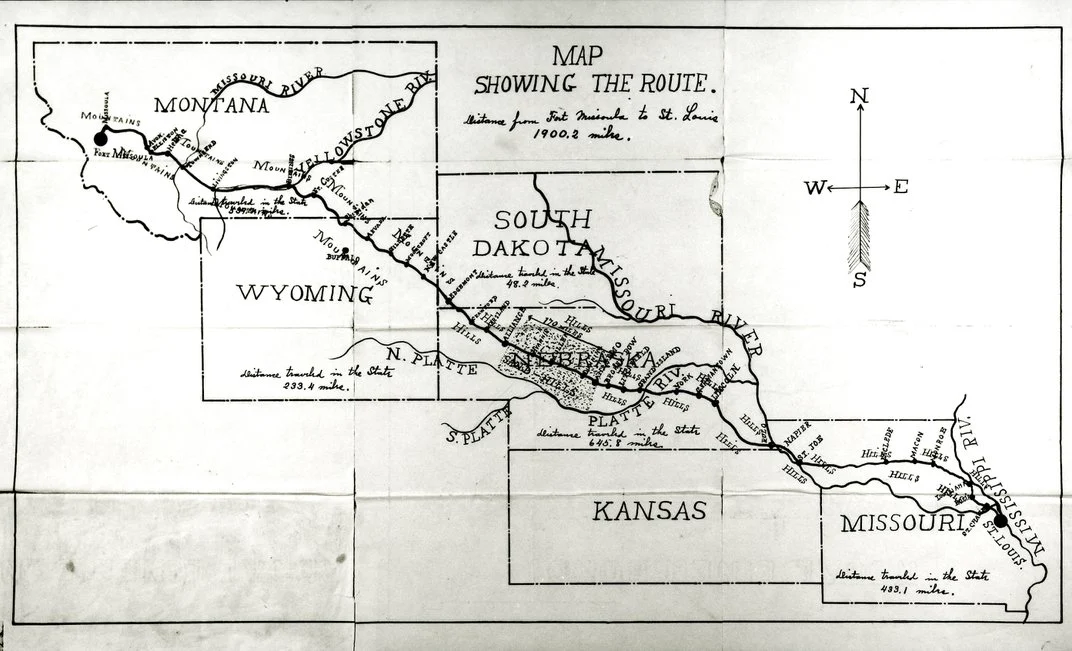
In 1897, the all-Black 25th Infantry Regiment Bicycle Corps embarked on an epic bicycle ride of more than 1,900 miles from Fort Missoula, Montana, to St. Louis, Missouri, as part of an experiment by the U.S. Army to determine the effectiveness of moving troops by bicycle. Called “The Great Experiment” in national newspapers, the journey took 41 days to complete. The route for the experiment closely followed the Northern Pacific and Burlington railroads through Montana, Wyoming, South Dakota, Nebraska and Missouri, and was chosen specifically to experience as many different conditions, climates and landscape formations as possible.
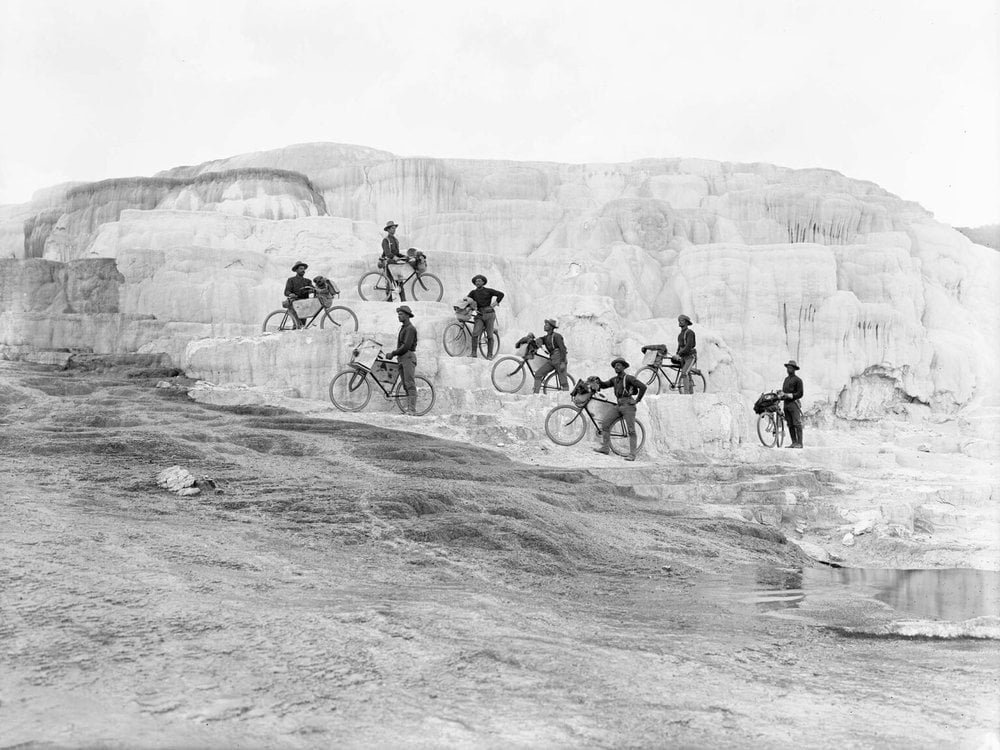
Buffalo Soldiers at Yellowstone, 1897 (Montana Historical Society)
The 25th Infantry was one of six racially segregated units formed by the Army after the Civil War. Soldiers in these units were required to continuously prove themselves to their white counterparts because of the perception that Black soldiers were inferior in courage and ability. Members of the Bicycle Corps demonstrated the opposite was true. Nicknamed the Iron Riders because of the heavy one-speed bicycles they pedaled and for their iron-hard constitutions, the soldiers endured conditions along the route that would have daunted even the most avid of modern-day cyclists: severe weather events, extreme heat, food and water shortages, illness from alkali poisoning, and racism and hostility from local residents. Despite these challenges, the Iron Riders successfully reached their final destination in St. Louis on July 24 and were welcomed by a crowd of 1,000 cyclists who escorted them into Forest Park.
Map of the Buffalo Soldiers' route from Montana to Missouri, 1897 (National Archives)
By 1897, the idea of using bicycles—introduced in the early 19th century and finetuned over the following decades—to transport troops had been around for some time. Some sources suggest that messengers and scouts fighting in the Franco-Prussian War of 1870 to 1871 used two-wheeled vehicles. Militaries in Britain, Spain and other countries tested bicycles and found they were well-suited for reconnaissance and delivering dispatches across a variety of terrain. Bikes also proved less expensive and easier to maintain than the horses typically used by cavalries.
In the U.S., Lieutenant General Nelson A. Miles—a veteran of the Civil War and the American Indian Wars—emerged as a key advocate of using bikes in the Army. Following the example of the First Signal Corps of the Connecticut National Guard, which in 1891 became the first American unit to formally utilize bicycles, Miles authorized several trials to determine the effectiveness of the new mode of transportation, including relay teams that delivered messages from Chicago to New York and Washington, D.C. to Denver.
Related pages
Current topics...
Archives...